 TILT Magazine~ Therapeutic Innovations in Light of Technology Archive (2010–2015)
Formatted archive of feature articles in all 21 issues of TILT Magazine
Access FULL Issues HERE.
Introduction
Published between 2010 and 2015, TILT Magazine (Therapeutic Innovations in Light of Technology) was the flagship publication of the Online Therapy Institute. Across 21 issues, the magazine explored the evolving relationship between technology and the helping professions, bringing together therapists, coaches, educators, researchers, and innovators from around the world.
At a time when online therapy, virtual worlds, avatar therapy, social media, telehealth, digital ethics, and cyberculture were still emerging conversations, TILT provided a forum for thoughtful discussion, research, practical applications, and professional innovation. The archive below highlights the major feature articles from each issue, along with the authors and themes that helped shape the conversation.
Viewed collectively, these issues offer a snapshot of a profession adapting to rapid technological change while remaining grounded in the enduring values of connection, ethics, learning, and human development.
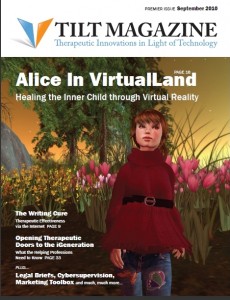
TILT Magazine – Premier Issue (September 2010)
The Writing Cure: Therapeutic Effectiveness via the Internet
By Cathryn Heyman & Cedric Speyer
This article explored the therapeutic value of online counseling through written communication. The authors examined how reflective writing, expressive disclosure, and asynchronous communication can foster insight, emotional processing, and meaningful therapeutic change.
Alice in VirtualLand: Healing the Inner Child through Virtual Reality
By DeeAnna Merz Nagel & Kate Anthony
Using the story of Alice and Lucy, this article explored how virtual environments and avatars can support healing, identity exploration, and therapeutic connection. It introduced readers to the emerging possibilities of virtual reality and avatar therapy as both a therapeutic medium and a way for clinicians to better understand clients who inhabit digital worlds.
Opening Therapeutic Doors to the iGeneration: What the Helping Professions Need to Know
By Marina London
This article examined the impact of technology on younger generations and explored how digital communication, social networking, and mobile technologies were reshaping relationships, learning, and help-seeking behaviors. It challenged helping professionals to better understand the experiences of digital natives.
Why This Issue Mattered
As the inaugural issue of TILT Magazine, this edition established the publication’s mission of exploring therapeutic innovations in light of technology. Long before telehealth became mainstream, the issue highlighted online counseling, virtual reality, digital identity, and generational shifts in communication—topics that would become central to the helping professions over the following decade.
TILT Magazine – Issue Two (November 2010)
Communication and Spiritual Autobiography: Means and Methods for Telling Your Story
By Alisa E. Clark
This article explored the use of technology in the creation and sharing of spiritual autobiographies. It examined how digital tools can support personal reflection, meaning-making, and the communication of spiritual narratives across distance and time.
Life 2.0: Virtual World, New Reality
By Kate Anthony & DeeAnna Merz Nagel
Drawing on the documentary Life 2.0, this article explored the growing intersection between physical and virtual avatar identities. It examined how people form relationships, construct meaning, and navigate complex emotional experiences in blended realities that span both online and offline worlds. This study of virtual worlds informs avatar therapy.
Online Mindfulness-Based Therapy: Convenient, Effective, and Affordable
By Peter Strong
This article examined the application of mindfulness-based therapeutic approaches through online technologies, particularly videoconferencing and blended communication methods. It highlighted the accessibility and effectiveness of delivering mindfulness interventions in digital environments.
Why This Issue Mattered
Issue Two expanded the conversation beyond online counseling into spirituality, mindfulness, virtual worlds, and digital identity. At a time when many clinicians still viewed technology as a barrier to meaningful connection, these articles demonstrated how technology could support reflection, presence, personal growth, and therapeutic engagement.
TILT Magazine – Issue Three (January 2011)
Navigating Conflicts by Email
By Paul Silverman
This article examined the challenges of managing misunderstandings and interpersonal conflict through email communication. It offered practical guidance for recognizing the limitations of text-based communication and resolving conflicts constructively in digital spaces.
An Ethical Framework for the Use of Social Media by Mental Health Professionals
By Kate Anthony, DeeAnna Merz Nagel & Keely Kolmes
This article introduced one of the field’s early ethical frameworks for clinicians using social media. It explored issues such as professional boundaries, online presence, client interactions, privacy, and the ethical challenges emerging from increased digital engagement by helping professionals.
Time for a Wedding! Ten Good Reasons for a Marriage Between Global Mental Health and the New Technologies
By Roos Korste
This article argued that technology had the potential to dramatically expand access to mental health services worldwide. It highlighted the opportunities for innovation, education, outreach, and service delivery that technology could offer to underserved populations across the globe.
Why This Issue Mattered
Issue Three marked an important shift toward professional ethics, global access, and the responsible use of emerging technologies. Years before social media ethics became a routine topic in professional codes and training programs, this issue addressed the practical and ethical implications of clinicians establishing an online presence and engaging with clients in digital spaces.
TILT Magazine – Issue Four (March 2011)
Online Coaching and Developing Relationships
By Yolanda Wysocki
This article explored how meaningful coaching relationships can be established and maintained in online environments. It challenged assumptions that strong rapport requires physical presence and examined the skills, attitudes, and technologies that support connection at a distance.
An Ethical Framework for the Use of Technology in Coaching
By Kate Anthony, DeeAnna Merz Nagel & Lyle Labardee
Developed in conjunction with the launch of the Online Coach Institute, this framework addressed ethical considerations for coaches using technology in practice. Topics included confidentiality, informed consent, professional boundaries, technology competence, and responsible service delivery.
From Therapist to Coach
By Casey Truffo
This article examined the transition from psychotherapy to coaching, highlighting differences in scope, focus, identity, and business models. It offered guidance for professionals considering expanding their work into coaching services.
Why This Issue Mattered
Issue Four marked the launch of the Online Coach Institute and broadened TILT’s focus beyond psychotherapy into coaching. It reflected a growing recognition that technology was reshaping multiple helping professions and that coaches, like therapists, needed ethical guidance and professional standards for online work.
TILT Magazine – Issue Five (May 2011)
Experiencing Presence: Some Thoughts
By Joy Waddington
Inspired by earlier discussions in TILT, this reflective article explored the concept of presence in therapeutic relationships. It considered how connection, attunement, and human presence can be experienced across physical and technological spaces.
Saving the Game: The Use of Gaming within Psychotherapy
By Mike Langlois
This article challenged negative stereotypes about gaming and explored how video games, virtual worlds and avatars can offer valuable therapeutic insights. Langlois argued that emotional experiences in digital environments are real experiences and deserve attention from helping professionals. Gaming within psychotherapy informs the broader intervention of avatar therapy.
Cutting Edge Technology to Aid People with Mental Health Issues
By David Haniff
This article surveyed emerging technologies designed to support mental health care and wellbeing. It highlighted innovative developments while emphasizing the need for research evaluating the effectiveness of technology-assisted interventions.
Why This Issue Mattered
Issue Five moved beyond online communication into the broader digital ecosystem of gaming, virtual worlds, and emerging technologies. Long before conversations about therapeutic gaming became mainstream, TILT was encouraging clinicians to look beyond pathology and understand how digital environments can support growth, identity, and healing.
TILT Magazine – Issue Six (July 2011)
Everyday Technology in Counselling and Supervision
Edited Keynote Address by Kate Anthony
Adapted from a keynote presentation for COSCA, this article explored the practical integration of technology into counseling, supervision, education, and professional practice. It highlighted how everyday technologies were already reshaping therapeutic work and professional development.
An Ethical Framework for the Use of Technology in Employee Assistance Programs (EAPs)
By Kate Anthony, DeeAnna Merz Nagel & Marina London
Created in collaboration with the Employee Assistance Professionals Association (EAPA), this framework extended TILT’s ethical work into the EAP sector. It addressed technology use in workplace mental health services, including confidentiality, service delivery, professional responsibility, and emerging ethical challenges.
Multiple Streams of Income for Therapists
By Casey Truffo
This article examined how therapists can build sustainable careers through diversified income streams while maintaining meaningful clinical work. It explored professional development, entrepreneurship, and adapting to changing economic realities.
Why This Issue Mattered
Issue Six demonstrated how TILT’s ethical frameworks were expanding beyond counseling and coaching into workplace mental health services. It also reflected a growing conversation about professional sustainability, innovation, and the practical realities of building careers in a rapidly changing technological landscape.
TILT Magazine – Issue Seven (September 2011)
The Rewarding Journey of Self-Publishing
By Courtney Armstrong
A practical exploration of how therapists and coaches can share their expertise through self-publishing, transforming blogs, ideas, and professional knowledge into books and educational resources.
Coaching and Counseling: Is There a Merge of the Disciplines on the Horizon?
By DeeAnna Merz Nagel & Kate Anthony
A thought-provoking discussion examining the similarities and distinctions between coaching and counseling, particularly in online environments where jurisdictional and professional boundaries become increasingly complex.
Public Mental Health Care in Canada
By Brett Goldenberg
An examination of how technology was beginning to transform public mental health systems and expand access to care.
Social Presence in Technology-Assisted Counseling
By Courtney Armstrong
Research exploring whether clients experience meaningful connection and presence online. Findings suggested little difference between online and face-to-face counseling regarding perceived presence and relational connection.
Why This Issue Mattered
Issue Seven marked TILT’s first anniversary and reflected a growing maturity in the field. Rather than debating whether online services were possible, contributors were examining how professional identities, coaching and counseling boundaries, social presence, and service delivery were evolving in a digitally connected world.
TILT Magazine – Issue Eight (November 2011)
Counselor Education in Second Life and 3VCC
By Debra London & Marty Jencius
An exploration of virtual learning environments and how counselor education programs were using immersive worlds for teaching, training, and professional development.
Engaging Gamers: The Evolution of Social Development in Gen X, Y and Z
By Shawn Ware-Avant
An examination of gaming culture, avatars, identity development, and the changing nature of social interaction across generations raised in increasingly digital environments.
Login2Life: Expanding the Cyberculture Point of View
By Kate Anthony & DeeAnna Merz Nagel
A reflection on the documentary Login2Life and the ways virtual worlds support identity, connection, and meaningful human and avatar experiences. The online gaming culture informs applicaations of avatar therapy.
Virtual Ability as Virtual Community
By Alice Krueger
A powerful example of how online communities can create accessibility, belonging, and support for individuals with disabilities through virtual environments and avatar identities, informing the use of avatar therapy as an intervention.
Why This Issue Mattered
Issue Eight feels remarkably ahead of its time. Long before conversations about the metaverse, digital identity, or virtual communities became mainstream, TILT was examining how immersive environments could support education, social connection, disability access, and mental health.
TILT Magazine – Issue Nine (January 2012)
A Serious Game to Help People with Depression
By Dave Haniff
An exploration of therapeutic gaming and interactive digital tools designed to support individuals experiencing depression.
Composing Oneself in E-Counselling
By Cedric Speyer & Eusebia da Silva
A case-based discussion exploring the thoughtful construction of therapeutic communication in email counseling and the importance of process, reflection, and clinical intention.
Practical Magic
By Kasia Zukowska
A practical introduction to encryption and online security, helping practitioners understand the technology that underpins safe digital communication.
Distance Counseling Survey Results
By Steven Starks
Results from an international survey of online practitioners, offering one of the early snapshots of who was providing online services, how they worked, and what the emerging field looked like.
Why This Issue Mattered
Issue Nine brought together three themes that would become defining concerns of the next decade: digital therapeutics, secure online communication, and practitioner research. The issue demonstrates how the field was beginning to move from experimentation into evidence gathering, professional standards, and practical implementation.
Issue 10 – Spring 2012
Advancing Lives Through the Science of Virtual Reality
By Tandra Allen
An exploration of virtual reality interventions developed through the Center for BrainHealth, examining how immersive environments and avatar therapy can help individuals, particularly those on the autism spectrum, improve social functioning and interpersonal skills.
Cyberspace as Culture: A New Paradigm for Therapists and Coaches
By DeeAnna Merz Nagel and Kate Anthony, with Gretta Louw
A foundational article proposing that cyberspace should be understood not merely as a communication channel but as a culture in its own right, requiring therapists and coaches to develop new forms of cultural competence.
The Social Media Coach
By Lynn Wernham
A research-informed examination of how coaches were beginning to incorporate social media tools into coaching relationships, including both opportunities and ethical considerations.
Why This Issue Mattered
Issue 10 represents one of TILT’s most visionary editions. It moved beyond discussions of online service delivery and began exploring cyberspace itself as a cultural environment, while simultaneously examining virtual reality and social media as emerging therapeutic and coaching tools.
Issue 11 – Summer 2012
Counseling Services and the Distance Learner
By Mary Ann Hollingsworth and Debbie Dean
An examination of how universities were adapting counseling services to meet the needs of online students, arguing that distance learners deserve access to the same level of mental health support as traditional campus populations.
The Dark Side of the Internet: A Story of Disinhibition and Murder
By Jean-Anne Sutherland
Using the documentary Talhotblond: Everybody Lies Online, this article explores the Online Disinhibition Effect and demonstrates how anonymity, fantasy, and deception can sometimes produce tragic real-world consequences.
The Online Couch: Mental Health Care is Going Online
By Jane Sarasohn-Kahn
A review of emerging online mental health services and the growing demand for technology-enabled care, while also examining barriers such as reimbursement, regulation, and adoption.
Why This Issue Mattered
Issue 11 balanced optimism about technology with a deeper examination of risk. Alongside discussions of distance counseling and online mental health services, it explored the darker dimensions of internet behavior and cyberpsychology, reminding practitioners that technological innovation always brings both opportunities and challenges.
Issue 12 – Fall 2012
First Chat: Attracting New EAP Users Through Online Text-Based Chat Services
By Barb Veder, Stephanie Torino, and Kelly Beaudoin
A look at Shepell•fgi’s innovative FirstChat service and how real-time text-based counseling was expanding access to Employee Assistance Programs for individuals who might not otherwise seek support.
Why Conventional Media Still Matters: Insights for Growing Your Practice
By Julie Hanks
A practical guide to using traditional media—including newspapers, radio, television, and online media appearances—to build professional visibility, credibility, and practice growth.
Online & Integrated Mental Health Support: The Range of Services at Turn2Me
By Eoin O’Shea
The story of Turn2Me, an innovative Irish online mental health organization founded in response to personal loss and designed to provide integrated support through forums, groups, educational resources, and online interventions.
Why This Issue Mattered
Issue 12 showcased how technology was broadening access to care in practical ways. From live text-based counseling and online support communities to media outreach and public education, the issue demonstrated that innovation was no longer experimental—it was becoming part of everyday professional practice.
Issue 13 – Winter 2013
The Real Motivation Behind Social Networking
By Dr. Aaron Balick
A psychodynamic exploration of social media use, examining how traditional theories of attachment, identity, and interpersonal relationships can help explain our online behavior and motivations.
A Distance Counselor’s “Ohanashi”: Coming to Work with People in Japan
By Roy Huggins
A fascinating reflection on counseling English-speaking residents of Japan, highlighting cultural differences around privacy, confidentiality, and the practical realities of delivering online counseling across cultures.
Ethical Framework for the Use of Technology in Supervision
By LoriAnn Stretch, DeeAnna Merz Nagel and Kate Anthony
Publication of OTI’s supervision framework, providing guidance for supervisors integrating technology into the supervisory relationship and extending the Institute’s growing body of ethical frameworks.
Why This Issue Mattered
Issue 13 reflects a growing maturity in the field. Rather than focusing solely on technology itself, the conversation shifted toward understanding the psychology behind technology use, cross-cultural applications of online practice, and the development of formal ethical frameworks to support emerging professional standards.
Issue 14 – Spring 2013
Online Therapy and Patient Engagement
By Jan Oldenburg
Featuring insights from DeeAnna Merz Nagel, this article explored how digital technologies were reshaping patient participation, communication, and engagement in healthcare and behavioral health settings.
Unlocking the Client’s Internal Dialogue with Virtual Worlds
By David Tinker
An introduction to ProReal, a virtual environment that allows clients to use metaphor, symbolism, and visual representation to explore personal challenges and facilitate insight and change through avatar therapy using metaphor and symbolism.
Social Skills Groups in the Virtual World
By Erin Sappio
A look at InWorld Solutions and the use of controlled virtual environments to support social skills development, role-playing, education, and therapeutic interventions, particularly for autistic youth through avatar therapy.
Skype and HIPAA: The Vexing Question
By Rene Quashie
A legal analysis of the ongoing debate surrounding Skype and HIPAA compliance, offering practical considerations for telehealth providers navigating rapidly evolving technology and privacy regulations.
Why This Issue Mattered
Issue 14 captured one of the most innovative periods in TILT’s history. Virtual worlds, avatars, metaphor-based interventions, patient engagement technologies, and telehealth compliance all converged in a single issue, illustrating how technology was expanding both the reach and the imagination of helping professions.
Issue 15 – Summer 2013
The Benefits of Therapeutic Writing
By DeeAnna Merz Nagel featuring Kathleen Adams
An exploration of journaling and expressive writing as therapeutic interventions, highlighting the work of Kathleen Adams and the influence of James Pennebaker’s research on writing and health.
The Benefits of Blogging for Better Student Writing
By Jessica Scott-Reid
An examination of how blogging can strengthen student engagement, writing skills, reflection, and digital literacy when paired with clear educational guidelines.
What’s Your Coaching Strategy?
By Kim Ades
A coaching-focused look at reflective writing and online journaling platforms as tools for maintaining client engagement, uncovering core beliefs, and supporting transformational coaching processes.
Why This Issue Mattered
Issue 15 broadened the conversation beyond technology as a delivery platform and into technology as a tool for reflection, learning, and personal transformation. Therapeutic writing, journaling, blogging, and digital coaching platforms demonstrated how technology could deepen self-awareness rather than simply facilitate communication.
Issue 16 – Fall 2013
The Client As Teacher: Experiences of a Writing Coach
By Gay Norton Edelman
Explores the reciprocal nature of helping relationships through the lens of writing coaching. The article emphasizes the importance of listening deeply to what clients know, do not know, and teach us through the coaching process.
Overcoming Concerns and Fears About Technology
By Martha Ireland
A personal account from a psychiatric clinical nurse specialist and psychotherapist describing the journey from technological skepticism to embracing technology as a meaningful extension of clinical practice.
Technology & Intrusive Thoughts (A Work in Progress)
By Dave Haniff
An exploration of emerging technologies—including virtual reality and speech-recognition tools—as possible interventions for unwanted and intrusive thoughts.
Why This Issue Mattered
Issue 16 marked a shift from discussing technology adoption to examining how technology transforms the helping relationship itself. Learning from clients, mentoring through digital environments, and developing innovative interventions became central themes.
Issue 17 – Winter 2014
From Snail Mail to Email to Private Conversation: Could Online Counselling Become Clients’ Preference?
By Dan Mitchell and Lawrence Murphy
Introduces PrivacEmail and the concept of layered written communication, exploring how secure asynchronous communication may evolve into a preferred mode of therapeutic interaction for some clients.
Aromatherapy Goes Digital: Why Nature Now Needs Technology: The Creation of LabAroma
By Colleen Harte
A fascinating intersection of complementary medicine and technology, examining how digital tools can support essential oil education, blending, and professional practice.
How Online Health & Wellness Got Its Silver Lining: The SilverCloud Health Story
By Ken Cahill
An inside look at one of the early innovators in digital mental health, introducing the SIPS model—Supportive, Interactive, Personal, and Social—as a framework for technology-assisted care.
Why This Issue Mattered
Issue 17 demonstrates how broadly OTI was thinking. Rather than limiting innovation to psychotherapy, the conversation expanded into coaching, wellness, complementary medicine, secure communication systems, and digital ecosystems of care.
Issue 18 – Spring 2014
Mentorship and the Path of E-Mastery
By Cedric Speyer featuring Professor Emeritus Tom Francoeur
A reflection on mentorship, professional development, and the power of written therapeutic communication. The article explores how mentorship shapes practitioners and how email-based interventions can support deep personal transformation.
Leaving a Legacy: The Generation Y Approach to Mental Health Solutions
By Emily Swinburn
The story behind the development of PlusGuidance, an online counseling platform inspired by a desire to improve access to mental health care and create meaningful social impact.
Using the Internet to Build a Dream: From Burnt-Out Psych Nurse to Thriving Wellness Coach
By Angela Brooks
An entrepreneurial story examining how blogging, social media, and online marketing can be used ethically to build a wellness-focused helping practice.
Why This Issue Mattered
Issue 18 reveals another important thread running through TILT and OTI: legacy. Mentorship, professional succession, online communities, access to care, and the creation of new pathways for future practitioners all take center stage. Technology becomes less about tools and more about transmission—of knowledge, wisdom, care, and possibility.
Issue 19 – Summer 2014
From Starting a Blog to Landing a Movie Deal… All on the WWW
By Darlene Ouimet
Darlene Ouimet shares her journey of healing from dissociation and chronic depression through her website and blog, Emerging from Broken. What began as a personal effort to share hope and recovery eventually led to an invitation to participate in a self-help film project, demonstrating the transformative potential of online storytelling and community.
“Tech Support” – Using Technology to Support Ongoing Recovery
By Susie Mullens and Teresa Warner
This article introduces A-CHESS, a recovery support application designed to help individuals maintain recovery between treatment encounters. Grounded in Self-Determination Theory, the platform enhances engagement, connection, accountability, and long-term support for people in recovery.
Kickstarter: A Warm Thank You to Our Supporters
By Kate Anthony and DeeAnna Merz Nagel
A reflection on TILT Magazine’s successful Kickstarter campaign and the community of readers, colleagues, and supporters who helped sustain the publication. The article highlights the growing role of crowdfunding in supporting innovative professional initiatives.
Why This Issue Mattered
Issue 19 focused on the power of community. Whether through recovery support networks, personal storytelling, or crowdfunding, technology was presented as a tool for connection, empowerment, and collective participation rather than simply information delivery.
Issue 20 – Fall 2014
Behavioural Pressure in Cyberspace: Building Internal Resources & Resilience in Young People
By Catherine Knibbs
This article examines the unique pressures young people face online and explores how parents, educators, and helping professionals can foster resilience rather than relying solely on restriction or protection. The focus is on developing internal resources that help youth navigate digital environments safely and effectively.
Online Social Gaming: Why Should We Be Worried?
By Kate Anthony and Mark Griffiths
An exploration of social gaming and the psychological mechanisms that make these platforms engaging and, at times, addictive. The article examines reward systems, behavioral reinforcement, and the similarities between certain gaming practices and gambling behaviors.
The CAM Coach: How Technology Supports Complementary & Alternative Practice
By Mark Shields
A practical look at how complementary and alternative medicine practitioners can use technology to build successful coaching and wellness practices. The article highlights online tools, communication platforms, and business strategies that support integrative approaches to care.
Why This Issue Mattered
Issue 20 demonstrated TILT’s expanding vision of cyberculture. Alongside concerns about gaming and youth resilience, the magazine highlighted the growing integration of technology within complementary and alternative health professions, reflecting OTI’s increasingly interdisciplinary approach
Issue 21 – Winter 2015
Immersion & Disinhibition: How the Internet Has Changed Our Learning
By John Wilson and Kate Anthony
This article explores how online learning environments shape participation, engagement, and collaboration. The authors examine the role of immersion, online interaction, and disinhibition in creating new opportunities for professional development and continuing education.
A Therapist and Coach Guide to Encryption
By Brian Dear
A practical guide to encryption, HIPAA compliance, and secure communication for therapists and coaches. The article translates complex technical concepts into accessible information, helping practitioners better understand privacy and confidentiality in digital practice.
Pathways to E-Mastery: A Supervisor’s Guidebook
By Cedric Speyer
Drawing on years of experience in online supervision, Speyer explores the development of competency, confidence, and mastery in digital helping professions. The article emphasizes mentorship, reflective practice, and the importance of professional growth in online environments.
Why This Issue Mattered
As the final issue in the archive, Issue 21 brought together many of TILT’s central themes: learning, supervision, ethics, technology competence, and professional development. It serves as a fitting culmination of five years of exploring how helping professionals can thrive in an increasingly digital world.
Conclusion
Over its five-year publication history, TILT Magazine documented the emergence of online helping professions and the growing influence of technology on therapy, coaching, supervision, education, wellness, and professional practice. The topics explored within these pages—virtual reality, social media, digital identity, online ethics, therapeutic writing, telehealth, gaming, cybersecurity, and cyberculture—continue to shape professional conversations today.
More than a magazine archive, TILT represents a record of inquiry, innovation, and collaboration during a period of significant transformation. It stands as part of the living legacy of the Online Therapy Institute and the many contributors who helped envision new possibilities for helping, healing, learning, and connection in a digital world.